Indoor Fairy Garden Ideas for Small Apartments
This post contains affiliate links. As an Amazon Associate we earn from qualifying purchases, at no extra cost to you.
You don’t need a backyard — or even a balcony — to create a magical fairy garden. Some of the most enchanting miniature worlds live happily indoors, on a windowsill, a bookshelf, or a coffee table. In a small apartment, an indoor fairy garden gives you a creative outlet, a conversation piece, and a little living green all in one. Here’s how to make one, and the ideas that work best in small spaces.
Why Indoor Fairy Gardens Are Perfect for Apartments
An indoor fairy garden is essentially a miniature landscape in a container — small enough to sit on a shelf, detailed enough to become its own little world. Unlike outdoor fairy gardens, which depend on weather and seasons, an indoor version stays beautiful and accessible year-round. It requires no outdoor space, creates almost no mess, and can be as simple or elaborate as you like. It’s also one of the most calming creative hobbies you can take up at home — arranging tiny plants and accessories is genuinely meditative, and the finished scene brings a quiet kind of joy every time you look at it.
Choosing Your Container
The container sets the tone for your whole fairy garden. Almost any vessel can work, which is part of the fun.
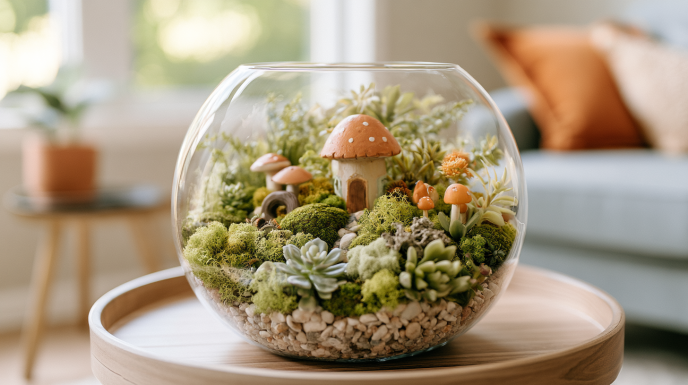
- Glass terrariums and bowls: Show the whole scene from every angle and create a jewel-like effect when lit well. Great for succulents and air plants on a bright windowsill.
- Wide shallow dishes or trays: Give you more horizontal space to create a landscape with paths, furniture, and multiple plants. Work well on a coffee table or shelf.
- Vintage teacups or mugs: Perfect for a single tiny plant and one small accessory — a miniature chair, a tiny house, a pebble. Charming as a desk or kitchen accent.
- Wooden crates or shadow boxes: Give a rustic, woodland look and can be hung on the wall for a vertical fairy garden that takes up no floor or shelf space.
- Hanging planters: Take your garden vertical and save surface space entirely.
- Vintage tins, drawers, or suitcases: Quirky, characterful containers that give your scene an instant story and personality.
Whatever container you choose, make sure it has drainage or that you build in a drainage layer (pebbles at the bottom), especially for planted containers where roots need to breathe.
Best Plants for Indoor Fairy Gardens
The key is choosing plants that stay small, grow slowly, and tolerate indoor conditions. Here are the best options by light level:
For Bright Windowsills (Direct or Strong Indirect Light)
- Succulents: Slow-growing, low-water, and available in beautiful shapes. Haworthia, echeveria, and sedum work especially well at small scale.
- Miniature cacti: Dramatic and architectural. Handle dry indoor air beautifully.
- Thyme and other creeping herbs: Tiny leaves, lovely texture, and you can snip them for cooking.
For Indirect or Lower Light
- Baby tears (Soleirolia): A ground-covering plant with tiny, delicate leaves that gives an instant lush, mossy look. Loves moisture and indirect light.
- Miniature ferns: Lush and forest-like. Prefer humidity, so a bathroom windowsill is ideal.
- Creeping fig (Ficus pumila): Fast-growing with tiny oval leaves that trail beautifully.
- Nerve plant (Fittonia): Striking veined leaves in pink, white, or red. Compact and vivid.
For Any Light
- Air plants (Tillandsia): Need no soil at all. Tuck them between pebbles, into driftwood, or into a tiny container of their own. Mist weekly. Perfect for unusual or delicate containers where soil would be messy.
- Preserved moss: Not alive but looks incredibly realistic. Zero maintenance, stays green indefinitely, and creates the perfect base layer for any scene.
Theme Ideas to Try
A cohesive theme pulls a fairy garden together and makes it feel like a real place rather than a collection of random objects. Here are some of the most popular and achievable:
- Woodland cottage: Moss as ground cover, a tiny wooden house with a pebble path leading to the door, miniature mushrooms, and perhaps a tiny lantern or bench tucked nearby.
- Enchanted forest: Miniature ferns and baby tears with hidden fairy figurines, a tiny wooden bridge, and tree bark pieces as texture.
- Succulent desert: A layer of sand or fine gravel, a mix of echeverias and haworthias, a few stones, and a tiny cactus sign for personality.
- Coastal scene: Sand, shells, driftwood, air plants, and a small mirror as a “rockpool.”
- Seasonal: Swap small accessories out for the season — tiny pumpkins in autumn, a miniature wreath in winter, spring flowers for Easter.
Accessories That Make the Magic
Plants create the living backdrop, but accessories tell the story. A few well-chosen pieces are far more effective than cluttering the scene. The essentials:
- One focal structure (a tiny house, door, or cottage)
- A path (pebbles, sand, or tiny stepping stones)
- One piece of furniture (a bench, chair, or table)
- One or two figurines (a fairy, a gnome, an animal)
- Natural texture (moss, bark, stones, sand)
Arrange as if you’re telling a small story. Leave open space — a fairy garden that’s too crowded loses its sense of wonder.
Placement and Ongoing Care
Place your indoor fairy garden where the plants’ light needs are met. Most living fairy gardens do best near a bright, indirect window. Water lightly and only when the soil or moss feels dry — indoor containers dry out much more slowly than outdoor ones, and overwatering is the most common problem. Rotate the container occasionally so all sides get even light, and refresh accessories, swap seasonal details, or add new plants as your garden evolves over time.
Start Tiny, Let It Grow
The best thing about an indoor fairy garden is that it doesn’t need to be finished to be enjoyed. Start with one container, one plant, and two or three accessories. Let it evolve as you find pieces you love, discover what grows well in your space, and develop your own style. There are no rules — just a tiny world that’s entirely yours to create.