Best Miniature Garden Accessories to Bring Your Scene to Life
This post contains affiliate links. As an Amazon Associate we earn from qualifying purchases, at no extra cost to you.
A miniature garden is more than a pot of small plants — it’s a tiny world. And what separates a truly magical scene from a plain collection of plants is the accessories. The right details — a little path, a wooden bench no bigger than your thumb, a fairy door propped against a mossy root — transform a container into somewhere your imagination can actually live. Here’s a guide to the accessories worth looking for, and how to use them well.
Why Accessories Make Such a Difference
Plants create the living backdrop — the trees, grass, and garden — but accessories give the scene its story. Without them, even a beautifully planted container looks like a pot. Add a winding pebble path, a tiny cottage with a glowing window, and a miniature garden bench, and suddenly there’s a whole world in there. The human brain is wired to respond to scale and narrative — we instinctively want to imagine who lives in that tiny house, who sits on that bench. That imaginative response is what makes miniature gardens so uniquely captivating, and it’s driven almost entirely by the accessories.
Focal Pieces: The Anchor of Your Scene
Every miniature garden needs one main focal piece that draws the eye and establishes the theme. This is usually a structure of some kind:
- Fairy houses and cottages: The classic. Available in wood, resin, ceramic, and metal. Styles range from rustic woodland to whimsical storybook to elegant stone.
- Miniature doors: A fairy door propped against a tree root or tucked at the base of a pot suggests a hidden world beneath. One of the most charming and affordable focal pieces.
- Castles and towers: More dramatic in scale. Work well in larger containers or as the centrepiece of a wide tray garden.
- Arched gateways and pergolas: Suggest entry to a garden space and work beautifully with climbing or trailing plants growing over them.
- Greenhouses and potting sheds: A wonderfully cozy focal piece for a “kitchen garden” themed scene.
Choose one focal piece that fits your theme and build everything else around it. Two competing focal points divide the eye and reduce the impact of both.
Paths and Ground Cover
A path is the single accessory that most convincingly sells the idea of a real garden in miniature. It implies distance, journey, and destination — all powerful tricks for the imagination.
- Pebble paths: Small, smooth stones arranged in a winding line. Natural, free if you have garden pebbles, and easily adjusted.
- Miniature stepping stones: Flat resin or stone pieces set into the soil. Give a more formal, garden-path look.
- Sand paths: Fine, light-coloured sand swept into a path. Works beautifully in desert or beach-themed scenes.
- Bark chip paths: Tiny wood chip pieces give a natural woodland feel.
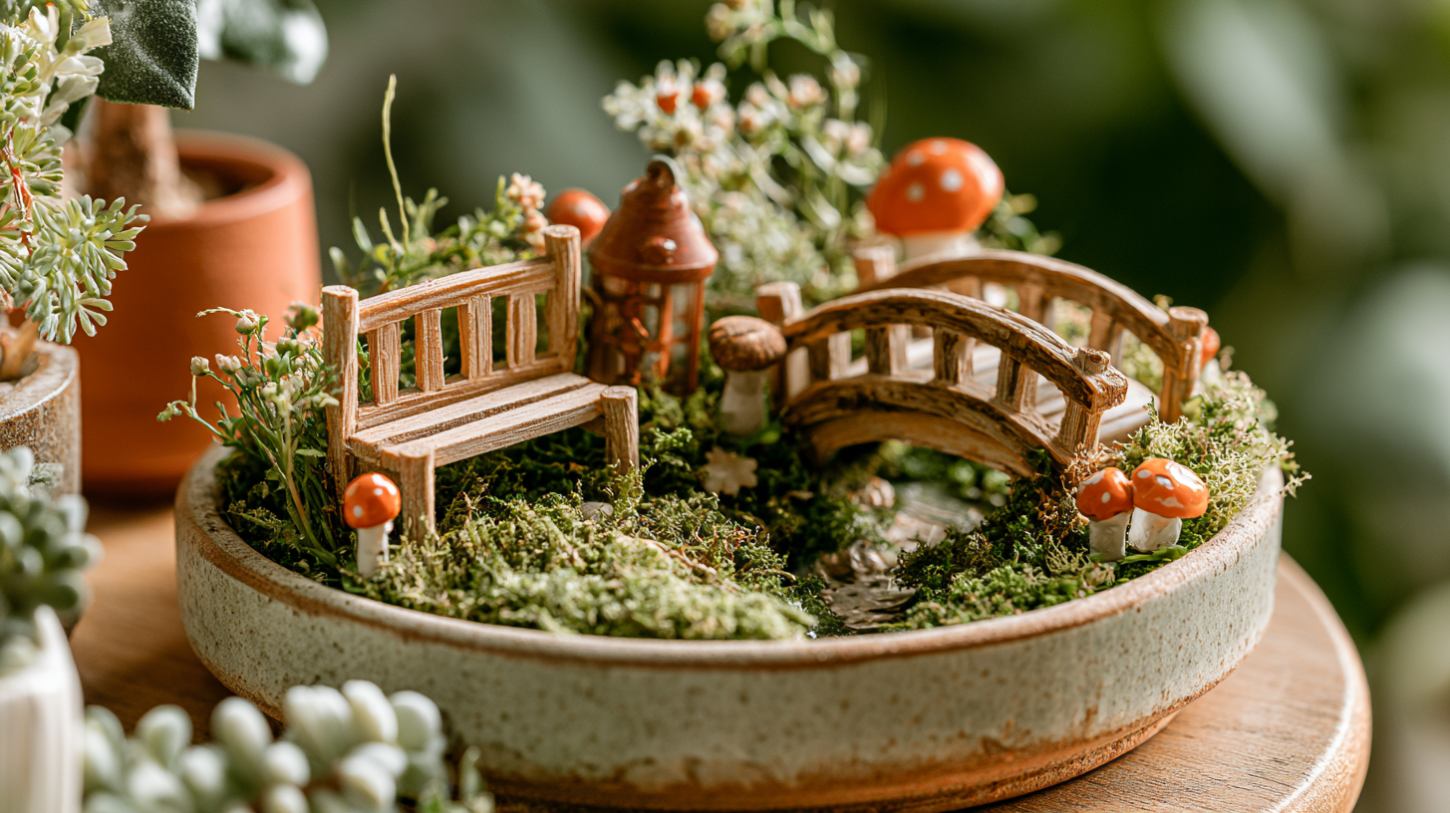
- Wooden bridges: A miniature bridge crossing a “stream” (a mirror, blue glass, or silver sand) is one of the most visually striking details in any fairy garden.
Furniture and Figurines
These are the details that suggest life — that someone inhabits this tiny world.
- Benches and chairs: A tiny garden seat under a plant “tree” is one of the most instantly charming details. Metal, wood, and resin all look good; match the material to your theme.
- Tables: A small table with two chairs suggests a gathering place. Add a miniature tea set for maximum whimsy.
- Lanterns: LED tea lights in tiny lanterns add a warm glow and work beautifully for evening display. Solar-powered versions are available for outdoor gardens.
- Fairy figurines: The inhabitants of your world. Choose poses that interact with the scene — sitting on the bench, tending the garden, sleeping under a leaf.
- Animals and birds: A tiny hedgehog, a rabbit, a bluebird perched on a fence — animal details add charm and feel completely natural in a garden setting.
- Signage: A tiny painted sign reading “Fairy Garden” or “This Way to the Magic” adds personality and a touch of humour.
- Mailboxes: A miniature letterbox on a tiny post is a quietly delightful detail that rewards close inspection.
Natural Texture Elements
Some of the best accessories are natural materials rather than manufactured pieces. These blend the artificial and the living parts of the scene seamlessly:
- Moss: Fresh, preserved, or dried. Used as ground cover, it creates an instant lush, green lawn. Preserved moss is the most practical — it stays green indefinitely without water.
- Miniature mushrooms: Resin or ceramic toadstools tucked at the base of plants give an instant fairy-tale feel.
- Bark and driftwood: Natural pieces add scale, texture, and the suggestion of fallen trees or ancient roots.
- Pebbles and gravel: Beyond paths, stones are useful for mulching between plants, creating “riverbeds,” and adding texture to bare soil.
- Mirror pieces: A small mirror placed flat in the soil becomes a pond or lake — surprisingly effective and beautiful.
- Crystals and sea glass: Add colour and a magical quality, especially around “water” features.
What to Look for When Buying
- Scale consistency: The most important rule. Mix pieces of wildly different scales and the illusion breaks. Look for accessories marketed specifically as “miniature garden” or “1:12 scale” for the most reliable sizing.
- Weatherproof materials: For outdoor gardens, choose resin, metal, or treated wood. Cheap painted plaster cracks and fades within a season outdoors.
- Quality over quantity: Five beautifully chosen pieces create a more magical scene than twenty cheap ones cluttered together. Edit ruthlessly.
- A cohesive colour palette: Even with varied materials, a consistent colour mood — earthy naturals, or all-green with white, or a warm terracotta palette — ties a scene together.
How to Arrange Accessories Well
Start with your focal piece and place it slightly off-centre — dead centre feels static. Add a path leading toward or away from it. Place furniture in natural positions: the bench in a clearing, the lantern by the door, the bridge over the “stream.” Add figurines last, positioning them as if they’ve just arrived or are going about their day. Step back frequently and assess the whole scene from a slight distance rather than looking straight down — this is how a visitor sees it, and it reveals whether the composition feels balanced.
Leave open space. A miniature garden that’s too densely packed loses the sense of a real place. The open areas — the lawn of moss, the clear pebble path — are as important as the filled ones.
Build It Slowly
The most charming miniature gardens are rarely built in one go. They grow over time as the gardener finds a perfect piece at a market, spots a lovely stone on a walk, or receives a tiny accessory as a gift. Give yourself permission to start small and add slowly. The best tiny worlds feel lived in and accumulated — not ordered from a list and assembled in an afternoon.