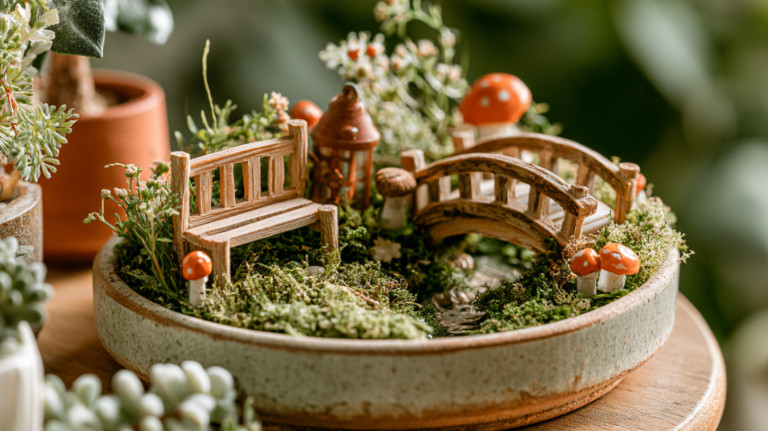
How to Make a Fairy Garden in a Teapot: Whimsical Miniature Magic in Vintage China
There is something irresistible about a fairy garden tucked inside an old teapot. The round body becomes a cosy little hollow, the spout turns into a winding path or a tiny slide, and the lid, propped open or set to one side, looks for all the world like a doorway into another world. If you have a chipped or mismatched teapot gathering dust in a cupboard, you already have the makings of one of the most charming miniature gardens there is.
A teapot fairy garden is perfect for small spaces. It sits happily on a windowsill, a shelf, or a garden table, takes only a handful of plants, and costs almost nothing if you upcycle a pot you already own. Here is how to build one that looks magical and keeps growing happily for months.
Why a teapot makes such a lovely fairy garden
A teapot has built-in character that a plain pot simply cannot match. Its curves feel storybook from the start, and all its little features practically beg to become part of a tiny landscape. The spout is a ready-made path or a tunnel a fairy might scamper through. The handle becomes a frame for a trailing plant. The lid can rest open like a little hatch or sit beside the pot as a pond.
Because the planting space is small, a teapot garden is quick to make and easy to keep looking neat, which makes it a brilliant first project. It is also a wonderful way to give a sentimental piece of china a second life, whether it is a car-boot find or a cup from a much-loved old set. If you enjoy working at this tiny scale, you will find the same joy in a teacup fairy garden, its smaller cousin.
What you will need
Start with a teapot that has a reasonably wide opening, since you will be planting through the top. A cracked or lidless teapot is perfect and often free. You will also need a little general-purpose compost, a handful of grit or fine gravel, one or two tiny plants, and whatever small decorations you fancy, such as pebbles, moss, and a miniature door or figure.
Because a teapot usually has no drainage hole, the trick to keeping your plants alive is a drainage layer. A few centimetres of grit or small stones in the base gives excess water somewhere to collect, away from the roots. Add a little horticultural charcoal if you have it, as it keeps the enclosed compost sweet and fresh.
Choosing the right tiny plants
The secret to a fairy garden that still looks magical in three months is choosing plants that stay genuinely small and slow-growing. In a teapot, with its limited compost, you really only have room for one or two, so make them count.
Tiny succulents are a brilliant choice because they cope well with the shallow, fast-draining conditions and need very little water. For a softer, more woodland look, a scrap of living moss, a baby fern, or a mind-your-own-business plant gives lush greenery at the right scale. Avoid anything labelled vigorous or fast-growing, because it will swamp the scene in no time. For more ideas on what thrives at this miniature scale, see our guide to the best plants for a fairy garden.
Planting your teapot step by step
Begin by spooning your grit or gravel into the base of the teapot to make the drainage layer. Then add compost on top, filling the pot most of the way but leaving a little room at the surface so water does not overflow the moment you pour it in.
Make a small well with your fingers or a spoon, settle your plant in gently, and firm the compost around its roots. Keep the planting slightly to one side if you want to leave an open area for a path or a tiny pond. Water sparingly to settle everything in, remembering that an enclosed teapot holds moisture far longer than an ordinary pot, so a little really does go a long way.
Adding the magic
Now comes the fun part, where a planted teapot turns into a world. Lay a few small pebbles leading from the spout to suggest a path spilling out of it, as though someone has just wandered down. Tuck a cushion of moss around the base of your plant to look like a tiny lawn, and prop a miniature door against the side of the pot so it seems to open into the teapot itself.
Keep the scale consistent and the decorations few. One perfectly placed little bench, a single tiny figure, or one small door almost always looks more enchanting than a crowd of ornaments fighting for space. A pinch of fine gravel for a stream bed or a tiny mirror for a pond adds a final sparkle. If you love the idea but want to keep your little scene indoors on a shelf, our indoor fairy garden ideas will help it thrive away from the weather.
Caring for your teapot garden
The biggest risk to a teapot fairy garden is overwatering, because there is nowhere for surplus water to escape. Feel the compost before you water and give only a small amount at a time, letting the surface dry slightly between drinks. If you ever see water pooling in the base, hold the pot at an angle over the sink to tip the excess out.
Stand your teapot where it gets bright, indirect light, and turn it now and then so the plants grow evenly. Pinch back any growth that starts to look too big, refresh the moss if it dries out, and your little china world will stay charming for a long time.
A tiny world worth the effort
A teapot fairy garden is proof that you do not need a garden at all to create something enchanting. With one forgotten piece of china, a scoop of compost, and a single little plant, you can build a complete miniature world that fits in the palm of your hands. Set it where you will see it every day, and let your imagination fill in the rest of the story.