Retractable Awnings for Small Patios: Instant Shade That Makes a Tiny Space Livable
There’s a cruel irony to small patios: the sunnier they are, the less you actually use them. A tiny south-facing patio can be unbearable from noon to five in summer, which is exactly when you’d like to be out there with a book or a cold drink. Umbrellas help, but they hog precious floor space and blow over in a breeze. A pergola is lovely but permanent, and in a truly small space it can feel like building a room you didn’t ask for.
This is where the retractable awning earns its keep. It mounts to the wall, takes up zero floor space, rolls out when the sun is fierce, and disappears when you want open sky. For small patios and even balconies, it’s one of the smartest shade investments you can make — and one that genuinely adds value to your home.
Why Retractable Awnings Suit Small Spaces So Well
The biggest advantage is simple: everything happens above your head. Unlike a cantilever umbrella with its heavy base, or a pergola with its posts, an awning leaves your entire floor free for furniture, planters, and feet. On a patio measuring three metres by three metres, reclaiming even one corner from an umbrella base changes how the whole space works.
The retractable part matters just as much. A small garden lives and dies by light — your pots, borders, and window boxes need sun for most of the day. A fixed canopy would cast permanent shade over plants that don’t want it. An awning shades the space only when you’re using it, then rolls away and gives the light back to your garden.
And because it retracts, it survives weather that would destroy a fixed canopy. Wind is the enemy of all overhead fabric; with an awning, you simply roll it in when the forecast turns.
Manual vs. Motorized: Which Should You Choose?
Manual awnings use a hand crank and cost significantly less — typically $150 to $600 for small sizes. Cranking takes about thirty seconds, which sounds trivial until you realize that any friction between you and using a thing means you use it less. Plenty of manual awnings spend their lives permanently rolled in.
Motorized awnings run from roughly $600 up to $2,500+ installed, operated by remote, wall switch, or increasingly by app. Some pair with sun and wind sensors that extend the awning automatically on bright days and retract it when gusts pick up — a genuinely useful feature if you’re out at work all day and worried about a surprise storm.
For a small patio, an honest rule of thumb: if the awning is under 3 metres wide and you’re on a budget, manual is fine. If you can stretch to motorized, you’ll use the awning three times as often, and the wind sensor pays for itself the first time it saves the fabric.
Getting the Size Right for a Small Patio
Awning sizes are quoted as width by projection (how far it extends from the wall). For small spaces, projection is the number to obsess over. A 2.5-metre projection shades a dining table; a 1.5-metre projection shades a doorway and not much else.
Measure at the times you actually sit outside. The sun moves, and shade cast at noon is very different from shade at 4pm, when the sun is lower and sneaks in under the front edge. Many awnings include a drop-down front valance for exactly this reason — worth having if your patio faces west.
Also check your mounting height. You need roughly 2.5 metres of clear wall above the door, and the extended awning should slope down to no lower than about 2 metres at the front edge so nobody clips their head.
What Do Retractable Awnings Cost?
Budget realistically in three tiers. Entry-level manual awnings (around $150–$400) are DIY-installable in an afternoon with a drill and a friend; the fabric is thinner and may fade in a few seasons, but they’re a fine way to test whether an awning changes how you use the space. Mid-range models ($400–$1,200) bring solution-dyed acrylic fabric that holds its color for a decade, sturdier arms, and optional motors. Premium installed awnings ($1,200–$3,500) come with full cassettes that seal the fabric away when closed, integrated LED lighting, sensors, and professional fitting — and typically 10-year warranties.
The fabric is where cheap awnings cut corners. Look for solution-dyed acrylic rather than polyester: it resists UV fading, sheds water, and doesn’t go brittle. A good frame with bad fabric is a bad awning.
Installation: Wall Type Matters More Than You Think
An extended awning acts like a sail, and all that force transfers to four or six wall brackets. Solid brick or block walls take standard expansion bolts. Cavity walls, cladding, and rendered insulation systems need specialist fixings or a spreader plate — this is the point where a professional install is worth the fee. Never mount an awning into mortar joints alone.
Renters and balcony gardeners aren’t out of luck: clamp-mounted balcony awnings and freestanding awning frames exist for exactly this situation, no drilling required.
Making the Shade Feel Like a Room
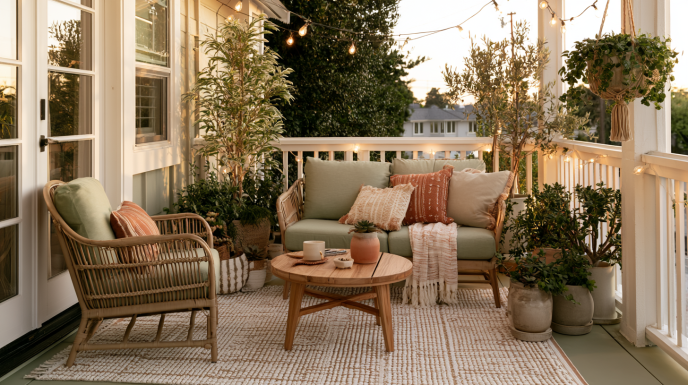
Once the awning is up, a small patio starts behaving like an outdoor room, and it’s worth furnishing it that way. Shade opens the door to plants that struggled in full blast sun — ferns, hostas, and begonias in pots will be happier under the awning’s edge. String lights along the front bar make the space usable after dark, and if you pair the awning with a patio heater, you’ve effectively added a three-season room to your home for a fraction of what a conservatory costs.
If your space gets strong sun from a low angle where an awning can’t reach, a shade sail can work alongside it beautifully — awning over the seating, sail over the corner the awning misses.
Quick Care Checklist
Awnings need very little: brush off debris before retracting, let wet fabric dry extended before rolling it in for long periods (mildew loves a damp rolled awning), retract in high wind, and give the fabric a gentle wash with soapy water once a season. Do that, and a decent awning will shade your summers for fifteen years or more.
The Bottom Line
For small patios, retractable awnings hit a sweet spot nothing else quite reaches: serious shade, zero floor space, and the flexibility to give your garden its sunlight back the moment you go indoors. Start with the projection measurement, insist on acrylic fabric, and be honest about whether you’ll crank a handle every day. Get those three things right and your hottest, least-used hours outdoors become the ones you look forward to.